








Pre-Game Routine: How to Build One That Actually Works
Most athletes do not have a pre-game routine, they have a pre-game panic. Here is how to build a simple routine that flips the switch every single game.

Most athletes do not have a pre-game routine. They have a pre-game panic. Scroll in the car, rush the warm up, eat whatever is in the bag, then hope the first shift fixes it. A real pre-game routine is the opposite of hope. It is a plan you run on autopilot so your head is free when the game starts.
You do not need to be superstitious about it. Same socks, same song, same left skate first, whatever. That stuff is fine but it is not the routine. The routine is the stuff that actually changes how you show up.
Why a pre-game routine matters more than you think
Here is what nobody tells young athletes. Your nerves are not the problem. Nerves are energy. The problem is uncertainty. When you do not know what the next two hours look like, your brain fills the empty space with worst case scenarios.
A routine kills that uncertainty. You know when you eat. You know when you start moving. You know what you think about in the last ten minutes. Your body learns the pattern, and after a few weeks the routine itself becomes the signal: time to go.
That is the whole point. You are building a switch you can flip on demand, on a good day, a tired day, a bad day. Every day.
Start the night before
The game does not start at puck drop. It starts the night before. If you go to bed at 1am after three hours of screens, no warm up in the world saves you.
- Pack your bag the night before. Every time. No 20 minute search for your other glove.
- Same bedtime as usual. Not earlier, you will just lie there. Not later.
- Know the plan. What time you leave, what time you eat, who is driving.
- Put the phone somewhere else. Your group chat can wait.
Boring? Yes. That is the idea. Boring the night before means calm the day of.
Game day: the simple timeline
Steal this and adjust it to your sport and your schedule. It is not a law. It is a starting point.
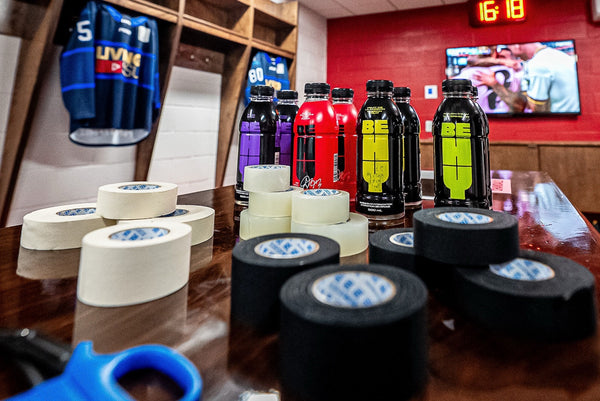
- 3 to 4 hours out: real meal. Carbs, some protein, not a ton of fat or fibre. Food you know sits well. Game day is not the day to try the new spicy thing.
- 2 hours out: hydrate and chill. Water through the afternoon, not a whole bottle chugged in the parking lot. Light stuff, a walk, some music.
- 90 minutes out: arrive. Not rushing through the door. Arriving early is the cheapest performance hack there is.
- 60 minutes out: move. Dynamic warm up, get the heart rate up, open the hips, a couple of short sprints. Sweat before you dress.
- 30 minutes out: gear and focus. Dress in the same order every time. This is where the switch gets flipped.
- Last 10 minutes: one thing. Pick one focus for the game. Just one. More on that below.
Warm up your body, not just your ego
A lot of athletes do the warm up for the audience. Couple of stretches, a few jokes, a lazy lap. Then the first ten minutes of the game becomes the real warm up and you are already down a goal.
Your warm up has one job. Get you to game speed before the game does it for you. That means you should actually be a little out of breath at some point. Short bursts. Change of direction. Hands and feet moving fast.
If you are cold on your first shift, your warm up did not work. Simple test. Be honest with yourself.
Pick one focus, not ten
This is the part most people skip, and it is the part that matters the most. Before the game, you pick one controllable thing to lock into. Not "score two goals". Not "don't mess up". Something you fully control.
- Win the first battle of every shift.
- Talk on every play.
- Stop on pucks, no swinging through.
- Get back hard on the backcheck, every time.
- Shoot when you have the look. No extra pass.
One. When the game gets chaotic, and it will, that one focus is your anchor. You come back to it after a bad shift. You come back to it after a goal against. It keeps you out of your head and in the game.
Use your breath like a tool
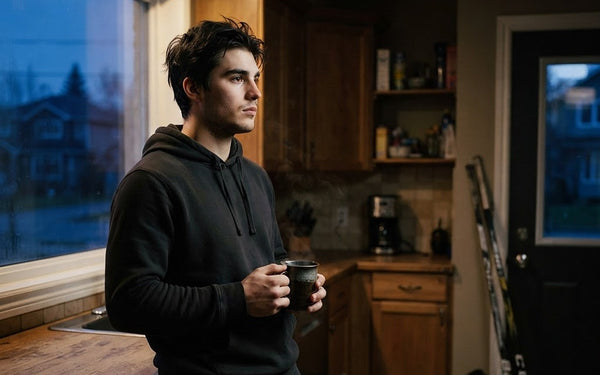
Your heart is pounding in the room. Good. That is normal. But you want to be in charge of it, not the other way around.
Try this before you walk out. Breathe in through the nose for four seconds. Hold for four. Out through the mouth for six. Do it five times. Longer exhale than inhale tells your nervous system you are not in danger. It takes about a minute and it works on the bench too.
Pros do this. It is not soft. It is control.
Keep it the same when things change
The real test of a routine is not the home game at 7pm. It is the 6am tournament game, the road trip, the late bus, the arena with no warm up space. Stuff changes all the time.
So build a short version. A 15 minute routine you can run anywhere: a few dynamic moves in a hallway, your breathing, your one focus. When the full routine is not possible, the short version still flips the switch. Having a plan B is what separates a routine from a ritual that falls apart the second something goes sideways.
Review it after, not during
After the game, take two minutes. Not to replay every mistake. Just to check the routine. Did you eat on time? Were you warm on the first shift? Did you stick to your focus?
Adjust one thing for next time. Over a season, those small tweaks build a routine that is completely yours. Built on evidence, not vibes.
The routine is the sisu
Sisu is not some big dramatic moment. Most of the time it looks like packing your bag on a Thursday night when you would rather be doing anything else. It looks like warming up properly when nobody is watching. It looks like doing the same boring things, the same way, until they carry you through the games that matter.
Talent shows up when it feels like it. A routine shows up every single time.
You handle the sisu. We handle the rest.
Being an athlete costs a lot, in money and in energy. The AthleteCard is how we take a bit of that weight off. Real deals on gear, gyms, nutrition, travel and recovery, plus a community of athletes who actually get the grind.
It is free. Always has been.